

1. The Biblical Archetype: Defining “Difficult Times” through 2 Timothy 3
In the study of political theology, the text of 2 Timothy 3:1-5 functions as a critical diagnostic rubric for evaluating the erosion of institutional and moral integrity.
The “perilous times” (chalepos) described by the Apostle Paul are not merely characterized by hardship, but by a systemic breakdown of the social contract and theological orthodoxy. For the scholar, these behavioral descriptors serve as markers of a deeper ideological shift toward radical subjectivism and the commodification of the divine.
Linguistic Synthesis of Moral Decay
A rigorous examination of the eighteen descriptors in the Greek text reveals a cascading collapse of the family and the state. The diagnostic begins with philautos (lovers of self) and philarguros (lovers of money), establishing a foundation of narcissism and greed that inevitably produces alazon (boastful) and huperephanos (arrogant) actors. This moral rot penetrates the domestic sphere through those who are apeithes (disobedient to parents), acharistoi (ungrateful), and anosioi (unholy).
Of particular strategic concern is the term astorgos (unloving/without natural affection), which denotes a lack of instinctive family love (storge), rendering the family unit—the building block of society—precariously fragile. This is amplified by the aspondos (irreconcilable), literally “without a libation,” describing those who refuse to enter a truce or covenant, and the diaboloi (malicious gossips), whose name implies “throwing between” to fracture relationships. These actors are akrates (without self-control), possessing no internal strength to govern their appetites, leading to anemeroi (brutal/savage) behavior and a hatred of the good (aphilagathoi). They are prodotes (treacherous), ready to betray trust for expediency, and propetes (reckless), plunging headlong into action without deliberation.
The Phenomenon of Morphosis
The diagnostic concludes with a profile of those who are tetuphomenoi—literally “swollen with smoke” or conceited—and philedonoi (lovers of pleasure) rather than philotheoi (lovers of God). The scholar must recognize the sophisticated hypocrisy of those “holding a form of godliness but denying its power.” This morphosis (outward appearance) is a mere silhouette of piety, a “spiritual masquerade” that utilizes religious terminology to mask a rejection of the Spirit’s transformative authority. This hollowed-out religion provides the necessary vacuum for the rise of contemporary movements that prioritize power over repentance.
2. The New Apostolic Reformation (NAR) and the Drive for Dominion
The New Apostolic Reformation (NAR) represents a profound ontological shift in contemporary Christianity, moving from a theology of “piety” to a hermeneutic of “Dominion.” Central to this is the “Seven Mountain Mandate,” a strategic framework designed to facilitate Christian dominion over the pillars of society: government, business, education, media, arts, family, and religion.
Core Tenets and the Heritage of Power
Rooted in the “Manifest Sons of God” movement and popularized by figures like C. Peter Wagner, the NAR asserts that modern-day “apostles” and “prophets” hold a mandate for spiritual warfare that is territorial in nature. This movement replaces the Great Commission’s focus on individual discipleship with a mandate for systemic conquest.
The Evaluation of Recklessness
Theological justifications such as the Cyrus Anointing and the Watchmen Decree provide a religious veneer for the pursuit of secular power. In the view of a senior scholar, these practices are the quintessential manifestation of being propetes (reckless) and tetuphomenoi (conceited). Issuing “decrees” over social and geographic territories demonstrates a lack of caution and a “swollen” view of one’s own importance. This “headstrong” approach ignores the biblical warning against those who “recklessly” plunge into matters beyond their deliberation, often resulting in an institutional erosion of democratic checks and balances.
3. The Age of Aquarius: Collective Consciousness and Spiritual Evolution
While the NAR focuses on structural dominion, the “Age of Aquarius” movement seeks an internal, evolutionary enlightenment. This movement promises a dawning era of global harmony achieved through a shift in the “Collective Consciousness.”
Epistemological Frictions
The New Age framework stands in stark contrast to traditional orthodoxy in three critical areas:
- Collective Consciousness vs. Individual Salvation: The Aquarian vision promotes a universal awakening where humanity transcends the “illusion” of individualism. Traditional theology, conversely, emphasizes individual accountability and the necessity of a personal response of faith to the Creator.
- Uniqueness of Christ vs. Blended Spirituality: While the New Age movement embraces an eclectic blend of intuition and “higher consciousness,” traditional doctrine maintains the uniqueness of Jesus Christ as the exclusive path to God (John 14:6).
- Self-Evolution vs. Grace: The pursuit of “self-driven spiritual evolution” via personal discovery rejects the biblical doctrine of “Grace Through Faith.” It replaces the necessity of repentance with a quest for personal empowerment, a functional rejection of external Scriptural authority in favor of subjective intuition.
4. Comparative Framework: Theological and Philosophical Frictions
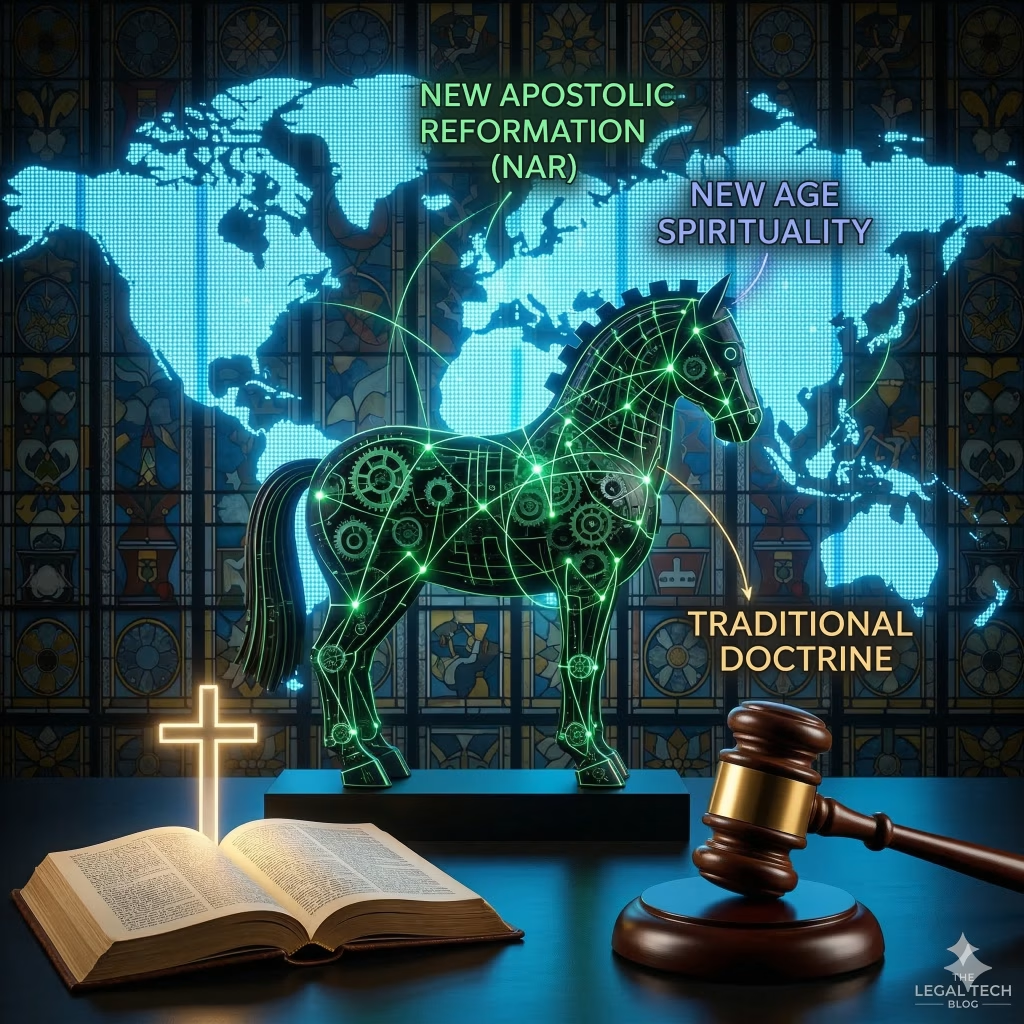
The intersection of these movements creates a “Trojan Horse” scenario within religious institutions, where the language of faith is used to deliver a payload of extra-biblical ideologies.
The Clash of Beliefs
The following table delineates the frictions between these frameworks:
| Feature | Traditional Theology | New Apostolic Reformation (NAR) | Age of Aquarius (New Age) |
| Source of Authority | Scripture (Divinely Inspired) | Modern Apostles / “New Revelations” | Intuition / Personal Experience |
| Nature of Salvation | Grace through Faith in Christ | Dominion, Victory, & Success | Self-Realization / Evolution |
| Social Objective | The Great Commission | Seven Mountain Mandate | Global Unity / Collective Awakening |
| View of the End | Return of Christ / Judgment | Kingdom established by “Sons” | Evolutionary Enlightenment |
| Human Nature | Fallen / In Need of Redemption | Empowered for Sovereignty | Divine / Evolving Consciousness |
The “Trojan Horse” Synthesis
A sophisticated assessment suggests that the New Apostolic Movement may effectively be the “New Age of Aquarius in disguise.” Both movements share a Gnostic reliance on “unseen” spiritual forces and prioritized extra-biblical revelation. They both seek to bypass the “power” of genuine godliness—internal moral renovation—in favor of manipulating spiritual reality to achieve utopian, man-made ends, whether through societal dominion (NAR) or evolutionary transcendence (New Age).
5. Civic Impact: Project 2025 and the Secular Governance Conflict
The ideological drive for dominion manifests concretely in “Project 2025,” a policy playbook designed to infuse “Christian Nationalism” into the administrative state. This initiative creates a severe structural tension between religious-based governance and the constitutional separation of powers.
Strategic Restructuring and Specific Proposals
Based on provided source context, Project 2025 outlines a radical overhaul of the civil service and federal agencies:
- Civil Service and Loyalty: The plan proposes reinstating “Schedule F,” reclassifying non-partisan civil servants as political appointees. This is supported by a “Presidential Academy” designed to cultivate loyalists who must sign an oath of loyalty to the President, replacing professional expertise with ideological alignment.
- Department of Health and Human Services (HHS): The rebranding of HHS as the “Department of Life” serves a specific agenda: criminalizing the mailing of medication abortion via the weaponization of the Comstock Act, and rescinding HIPAA protections for reproductive medical records to allow state surveillance.
- Education and Labor: The framework seeks to eliminate the Department of Education, privatize schools, and require “military entrance exams” for all students in schools receiving federal funds. Notably, it proposes a “time and a half” pay requirement for Sunday work—not as a labor protection, but as a mechanism to encourage “communal rest” and return the populace to church.
The Mechanism of “Religious Exemptions”
By weaponizing “religious exemptions” as a legal lever, the Project 2025 framework seeks to dismantle established civil rights protections under the guise of piety. This creates a politico-religious infrastructure capable of facilitating systemic discrimination against a broad spectrum of the populace. Far from protecting faith, this power play risks the active persecution of all dissenters—including traditional Christians who remain committed to the eternal Kingdom of Jesus. This stands in stark contrast to the “Kingdom Now” “dominionism” of the New Apostolic Reformation and its “Manifest Sons of God” theology, which prioritizes the seizure of temporal authority over the transformative power of the Gospel.
6. Synthesis and Assessment Summary
The convergence of 2 Timothy 3’s behavioral markers with the NAR and New Age movements reveals a cohesive threat to both theological orthodoxy and democratic governance.
Critical Takeaways
- Institutional Erosion through Subsidiarity: Both the NAR and New Age movements promote a “higher type of morality” that replaces biblical adherence with subjective intuition or apostolic decree. This erodes the authority of the Word and the stability of the institution.
- Hyper-Patriarchy and the Hierarchy of Control: The “hyper-patriarchy” observed in these movements twists the biblical concept of submission into a rigid “rulership.” This “hierarchy of control” ignores the mutual submission commanded in Scripture, leading to an authoritarian social structure that mirrors the “brutal” and “heartless” descriptors of 2 Timothy 3.
- The Weaponization of Morphosis: The “form of godliness” has been successfully weaponized into a political tool. By prioritizing a “Cyrus” figure who offers power over a Christ figure who offers redemption, these movements facilitate a “reckless” plunge into Christian Nationalism that endangers the pluralistic landscape of the republic.
In summary, the biblical directive to “avoid such men” (2 Tim 3:5) is both a theological and civic imperative. Those who trade the internal power of faith for the external pursuit of dominion represent the very “perilous” agents against whom the Apostle warned. To maintain institutional integrity, one must reject these “Christian charlatans” who have exchanged the grace of the Gospel for the raw pursuit of power.
Discover more from Discernment Watch
Subscribe to get the latest posts sent to your email.